

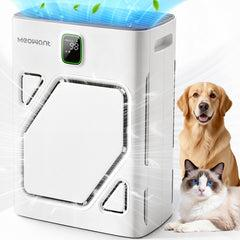
The pet air purifier market runs on confidence. Packaging promises hospital-grade air, silent operation, and odor elimination, and shoppers who want relief from hair, dander, and litter smells rarely have time to check the claims. The result is a predictable pattern: people buy on a catchy label, then discover that their machine does little for the problem they actually cared about. Some of these beliefs are harmless oversimplifications. Others lead directly to wasted money and a room that still smells. This article sets out the most common myths, explains what the evidence actually shows, and describes the practical habits that make a purifier work in a home with animals.
Myth One: Any Purifier Clears Pet Odor
The most expensive misconception is that a machine built for pollen and dust will also handle ammonia. It will not, unless it includes a substantial carbon stage. HEPA media catches particles, and odor molecules are gases far smaller than the gaps between fibers. Without carbon to adsorb them, those molecules pass straight through. Buyers who compare units only on HEPA ratings often end up with a purifier that removes dander while the litter box smell persists.
What Actually Clears the Air
Effective odor control needs two things working together: a filter that captures the particles carrying odor, and carbon that traps the gases themselves. The carbon must be present in meaningful quantity and replaced on schedule. A thin layer sprayed onto a mesh saturates quickly, at which point the unit starts recycling odors back into the room. When you compare models, look at the carbon specification and the cost of replacement filters, not just the particle rating.
Myth Two: Bigger Filters Always Mean Better Cleaning
A larger filter holds more material before clogging, which is genuinely useful. But cleaning performance depends on how much air moves through the filter in a given hour. A large filter behind a weak fan can clean less air than a smaller filter in a stronger machine. This is why clean air delivery rate exists as a standard: it measures output, not surface area. Shoppers who choose the unit with the biggest filter often pay for capacity the fan cannot use.
Reading the Numbers That Matter
Look for a stated CADR for smoke, dust, and pollen, along with a recommended room size that matches your actual space. Then check the noise rating at the speed you will realistically use. A machine that only reaches its rated airflow at a setting too loud for your living room will never deliver the advertised performance in daily life. Pair those figures with filter cost and you have a realistic picture of what the unit will do.
Myth Three: A Purifier Replaces Cleaning
No filter can keep pace with a full litter drawer or a sofa covered in hair. Purifiers work best as a supplement to routine cleaning, clearing the fine particles and gases that vacuuming and scooping leave behind. Homes that rely on filtration alone tend to see diminishing returns, because the source keeps producing more material than the machine can process. The room improves when the box is clean, the floors are vacuumed, and the purifier handles what remains in the air.
Myth Four: Ozone and Ionizers Are Safe Shortcuts
Some units advertise ionizers or ozone generation as a way to neutralize odors without filters. Ozone is a respiratory irritant, and health agencies advise against using devices that intentionally produce it in occupied spaces. Ionizers can reduce particles but often generate trace ozone as a byproduct and do little for gases. For a pet household where animals and people share the same air, mechanical filtration with carbon is the safer and more predictable choice.
Marketing language can blur this distinction. A unit labeled as an air ionizer may still include a filter, and a purifier may include an ionizer as an optional setting. Read the specification rather than the front of the box, and favor designs that rely on filtration as the primary mechanism.
Myth Five: You Can Set It and Forget It
A purifier is a machine with consumable parts, and its performance declines quietly as filters load up. Owners who never check the filter often conclude that the unit stopped working when the real issue is restricted airflow. A clogged pre-filter is the most common culprit in pet homes, since hair builds up faster than the manual suggests. Vacuuming the pre-filter weekly and replacing carbon when odor returns keeps performance close to new.
Meowant builds its purifiers with front-accessible filter bays, a detail that matters more than it sounds. If servicing takes less than a minute, owners actually do it, and the unit keeps working as intended. The same principle applies to sensor cleaning: a dusty particle sensor misreads the room and runs the fan at the wrong speed all day.
Myth Six: More Power Always Means Better Air
Cranking a purifier to its highest setting feels productive, but noise and turbulence have costs. High airflow stirs up settled dust and can make a room less comfortable, especially at night. A steady medium setting that cycles the air continuously usually produces better results than intermittent bursts at maximum speed. In most homes, the goal is consistent background filtration rather than dramatic short-term cleaning.
Placement also shapes perceived power. A unit in the open, with clearance on all sides, moves air far more effectively than one pressed into a corner or behind furniture. Before assuming a machine is underpowered, check whether it can actually draw in room air where it sits.
The same reasoning applies to automatic modes. A sensor that triggers high speed every time a pet walks past can make a quiet machine feel frantic, while a steady setting keeps the room calmer and the airflow predictable. For most pet homes, a moderate constant speed outperforms reactive bursts, especially overnight when sudden fan changes disturb both people and animals.
What to Do Instead
One more claim deserves scrutiny: that a purifier can make a home allergy-free. It cannot. Filtration lowers airborne exposure, but allergens remain on surfaces and in soft furnishings. Buyers who expect a sterile room are disappointed, while those who expect meaningful improvement are usually satisfied. Choose the latter expectation and the machine will meet it.
Start with the source. Keep the litter box clean, use a design that seals waste promptly, and vacuum regularly. Then choose a pet air purifier with real carbon, adequate airflow for your space, and a quiet low setting you will leave on. Maintain it on schedule, and place it where it can reach the air that needs cleaning. These steps cost less than chasing premium labels and deliver results you can actually notice.
Another quiet cost is the false confidence a purifier can create. Feeling that the air is handled sometimes leads owners to skip scooping or delay vacuuming, which raises the source load faster than any filter can clear it. Keep the cleaning routine intact and let the purifier work as support, not as an excuse.
Finally, judge performance by your own experience rather than by a marketing number. Note how the room smells and feels over a week of normal use, and adjust placement or maintenance based on what you observe. A purifier that fits your habits will always beat a more expensive one that sits ignored in a corner.
Be equally skeptical of sensor displays that promise precise readings. Consumer-grade sensors estimate particle levels and drift as dust collects on the lens. They are useful as rough guides, not as measurements. If the display reads clean while the room still smells, trust your nose and check the carbon stage, because many sensors do not detect gases at all.
Reviews deserve careful reading too. Look for owners who describe long-term use and maintenance, not unboxing impressions. A unit that performs well for a month and then loses airflow tells you more about its filter design than any five-star rating written on day one.
Buy on Evidence, Not Slogans
Most pet air purifier disappointment traces back to a handful of myths: that any unit handles odor, that bigger filters always win, that filtration replaces cleaning, and that ozone is a shortcut. None of these hold up under scrutiny. Focus on carbon for gases, airflow for particles, quiet operation for daily use, and maintenance for long-term performance. Spend accordingly, run the machine consistently, and the air in your home will improve in ways a slogan never could.
